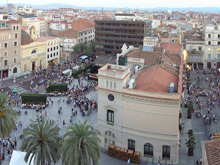
Sabadell
In the city of Sabadell, all the women who attended the pregnancy care program and who had an ultrasound of their first trimester of pregnancy at CAP II Sant Felix (the only specialized primary care center in Sabadell the city) between July 2004 and In July 2006, they were invited to participate in the INMA study. A total of 657 women were included, who were followed in each trimester of pregnancy until the time of delivery at the Hospital de Sabadell (Corporació Sanitària Parc Taulí) which covers the entire population of Sabadell, acting as a specialized hospital of consultation and reference for. part.
An additional round of hiring pregnant women was held between May 2007 and July 2007, but directly when they went to give birth at Sabadell Hospital. A total of 120 women were included in this second phase.
Over the years, this group of children from the city of Sabadell have been evaluated approximately every 2 years, thanks to the predisposition of their families: that is, at 6 and 14 months, at 2, 4, 7, 9, 11 and 14 years. In July 2023 we have started the 18 years visit, and it is wonderful to acknowledge the valuable selfless collaboration of these young people, thanking them for their participation and commitment. Thank you for being part of this journey towards a brighter future.
-
Collaborating Entities







-
Processing of Data and Samples:
How do we treat your personal data and the biological samples we collect?
The data of the INMA-Sabadell birth cohort collected in the context of the INMA Project are kept at the Institut de Salut Global Barcelona (ISGlobal)
– Responsible for the Treatment: Private Foundation Instituto de Salud Global Barcelona (ISGlobal)
– CIF: G65341695
– Postal address: Carrer Rosselló, number 132, 2ª, 5ª and 7ª in Barcelona (08036)
– Telephone: (+34)932271806
– Data Protection Delegate, contact: lopd@isglobal.org
The data are treated with absolute confidentiality and in accordance with Regulation (EU) 2016/679 of the European Parliament and of the Council, of April 27, 2016, relating to the protection of individuals with regard to the processing of personal data and to the free circulation of this data and to Organic Law 3/2018, of December 5, on the protection of personal data and the guarantee of digital rights.
Health data is kept separate from personal data. Data dissociation means that your health information cannot be associated with you as your personal data is replaced by a numeric code. Dissociated information is archived for use by project researchers and their research partners. All the results of the study are presented in a database of the group of participants, data is never presented individually.
Personal data will be kept as long as the research project or successive projects within the same line of research is active, in this way your data may also be used by other projects / research within the area of the present project , or in global health research projects, both in infectious and non-communicable diseases, and environmental health, to study the effect of environmental factors on people’s health.
You are responsible for the veracity and correctness of the data you provide us and you have the right to exercise the rights of access, rectification, deletion, limitation of treatment, portability and opposition of your data in accordance with what has the regulations on data protection. To exercise them, you must write to the Data Protection Officer at lopd@isglobal.org and you must attach a photocopy of your national identification document or the equivalent. In addition to the possibility of exercising your rights, if you do not agree with the treatment carried out by the Entity or if you consider that your rights have been infringed, you can submit a claim at any time to the Spanish Data Protection Agency.
Biological samples are treated in accordance with current legislation (Law 14/2007 on biomedical research, and Royal Decree 1716/2011 regulating the use of biological samples for research). The samples are stored in the ISGlobal biobank, at Campus Mar (Barcelona Biomedical Research Park) and are included in collection C.0001626 included in the Registry of Collections of the Instituto de Salud Carlos III. These are only used in research projects directly related to the INMA Project and with the aim of studying biomarkers related to the effect of environmental factors on health.
The data obtained from the use of these samples will be treated in the same way as the rest of the data obtained in this study.
The provision of biological samples for this study is free and voluntary. This assumes that you will have no rights to potential commercial benefits from discoveries that may result from the biomedical research.
Finally, if you decide to withdraw your consent to participate in this study, no new data will be added to the database from the date you inform us that you decide to withdraw, and only the data obtained up to that time will be retained, to ensure the validity of the research. You can also request that the identifiable biological samples obtained so far be destroyed, so that no further analysis can be carried out.
Buscador
Prenatal and childhood exposure to mixtures of environmental chemicals and adolescence attentional problems: a triangulation study
Fabbri L, Andrušaitytė S, Basagaña X, Bhopal S, Bustamante M, Cheung RW, Gražulevičienė R, Guxens M, Kadawathagedara M, Kampouri M, Maitre L, Marquez S, Montazeri P, Myridakis A, Slama R, Thomsen C, Vrijheid M. Prenatal and childhood exposure to mixtures of environmental chemicals and adolescence attentional problems: a triangulation study. Environ Int. 2025 Dec;206:109927. PMID: 41252940
Early-life exposome and health-related immune signatures in childhood
Amine I, Anguita-Ruiz A, Guillien A, Basagaña X, Bustamante M, Borràs E, Cirach M, Dedele A, Dobaño C, Garcia-Aymerich J, Granum B, Grazuleviciene R, González JR, Julvez J, Keun H, López-Vicente M, McEachan R, Moncunill G, Nieuwenhuijsen M, Sabidó E, Slama R, Tenenhaus A, Vafeiadi M, Wright J, Yang T, Yuan WL, Vrijheid M, Siroux V, Maitre L. Early-life exposome and health-related immune signatures in childhood. Environ Int. 2025 Aug;202:109668. PMID: 40651279
Biological sex impacts immune cell proportions and epigenetic profiles in the developing pediatric immune system
Edwards K, Merrill SM, Konwar C, Jude MS, Zhuang BC, Meijer M, Navarro-Delgado E, MacIsaac JL, Mandhane P, Simons E, Moraes TJ, Azad MB, Subbarao P, Bustamante M, Vrijheid M, Turvey S, Kobor MS. Biological sex impacts immune cell proportions and epigenetic profiles in the developing pediatric immune system. Commun Biol. 2025 Oct 9;8(1):1447. PMID: 41068453
Maternal asthma and newborn DNA methylation
Pedersen CT, Hoang TT, Jin J, Starnawska A, Granell R, Elliott HR, Huels A, Zar HJ, Stein DJ, Zhang Y, Dekker HTD, Duijts L, Felix JF, Sangüesa J, Bustamante M, Casas M, Vrijheid M, Kadalayil L, Rezwan FI, Arshad H, Holloway JW, Röder S, Zenclussen AC, Herberth G, Staunstrup NH, Horsdal HT, Mill J, Hannon E; iPSYCH-MINERvA Group; Annesi-Maesano I, Pesce G, Baïz N, Heude B, Hosseinian-Mohazzab S, Breton CV, Harlid S, Harbs J, Domellof M, West C, Yeung E, Zeng X, Nystad W, Håberg SE, Magnus MC, Schendel D, London SJ, Bønnelykke K. Maternal asthma and newborn DNA methylation. Clin Epigenetics. 2025 May 10;17(1):79. PMID: 40349045
Epigenetic timing effects on child developmental outcomes: a longitudinal meta-regression of findings from the Pregnancy And Childhood Epigenetics Consortium
Neumann A, Sammallahti S, Cosin-Tomas M, Reese SE, Suderman M, Alemany S, Almqvist C, Andrusaityte S, Arshad SH, Bakermans-Kranenburg MJ, Beilin L, Breton C, Bustamante M, Czamara D, Dabelea D, Eng C, Eskenazi B, Fuemmeler BF, Gilliland FD, Grazuleviciene R, Håberg SE, Herberth G, Holland N, Hough A, Hu D, Huen K, Hüls A, Jarvelin MR, Jin J, Julvez J, Koletzko BV, Koppelman GH, Kull I, Lu X, Maitre L, Mason D, Melén E, Merid SK, Molloy PL, Mori TA, Mulder RH, Page CM, Richmond RC, Röder S, Ross JP, Schellhas L, Sebert S, Sheppard D, Snieder H, Starling AP, Stein DJ, Tindula G, van IJzendoorn MH, Vonk J, Walton E, Witonsky J, Xu CJ, Yang IV, Yousefi PD, Zar HJ, Zenclussen AC, Zhang H, Tiemeier H, London SJ, Felix JF, Cecil C. Epigenetic timing effects on child developmental outcomes: a longitudinal meta-regression of findings from the Pregnancy And Childhood Epigenetics Consortium. Genome Med. 2025 Apr 14;17(1):39. PMID: 40229801
Outdoor air pollution, road traffic noise, and allostatic load in children aged 6-11 years: evidence from six European cohorts
Mou Y, Kusters MSW, Robinson O, Maitre L, McEachan RRC, Yuan WL, Hjertager Krog N, Andrušaitytė S, Bustamante M, de Castro Pascual M, Dedele A, Wright J, Grazuleviciene R, Aasvang GM, Lepeule J, Nieuwenhuijsen M, Tiemeier H, Vrijheid M, Thomson EM, Guxens M. Outdoor air pollution, road traffic noise, and allostatic load in children aged 6-11 years: evidence from six European cohorts. Eur J Epidemiol. 2025 May;40(5):537-548. PMID: 40366609
Epistasis of ERAP1 With 4 Major Histocompatibility Complex Class I Alleles in Frontal Fibrosing Alopecia: A Genome-Wide Association Study Meta-Analysis
Rayinda T, Dand N, McSweeney SM, Christou E, Ung CY, Stefanato CM, Fenton DA, Harries M, Palamaras I, Tidman A, Holmes S, Koutalopoulou A, Ardern-Jones M, Kaur M, Papanikou S, Chasapi V, Vañó-Galvan S, Saceda-Corralo D, Melián-Olivera A, Azcarraga-Llobet C, Lobato-Berezo A, Bustamante M, Sunyer J, Starace MVR, Piraccini BM, Wiss IP, Senna MM, Singh R, Hillmann K, Kanti-Schmidt V, Blume-Peytavi U, McGrath JA, Simpson MA, Tziotzios C. Epistasis of ERAP1 With 4 Major Histocompatibility Complex Class I Alleles in Frontal Fibrosing Alopecia: A Genome-Wide Association Study Meta-Analysis. JAMA Dermatol. 2025 Mar 1;161(3):310-314. PMID: 39937552
Genetic characterization of preschool wheeze phenotypes
Fischer-Rasmussen K, Granell R, Eliasen AU, Kreiner E, Pedersen CT, Luo Y, Chawes B, Stokholm J, Malby Schoos AM, Kumar A, Nybo Andersen AM, Feenstra B, Geller F, Siroux V, Demenais F, Bouzigon E, Jaddoe V, van der Valk RJP, Duijts L, Sunyer J, Guxens M, Marinelli M, Bustamante M, Heinrich J, Standl M, Curtin J, Simpson A, Murray C, Jacobsson B, Myhre R, Pennell CE, Daley D, Ober C, Gern JE, Jackson D, Boomsma DI, Hottenga JJ, Abdellaoui A, Holloway JW, Collins S, Turner S, Arshad SH, Ullah A, Melén E, Henderson J, Bisgaard H, Pedersen AG, Custovic A, Vonk JM, Koppelman GH, Kabesch M, Bønnelykke K; Multidisciplinary Study to Identify the Genetic and Environmental Causes of Asthma in the European Community (GABRIEL) consortium; EArly Genetics and Lifecourse Epidemiology (EAGLE) consortium. Genetic characterization of preschool wheeze phenotypes. J Allergy Clin Immunol. 2025 Dec;156(6):1537-1546. PMID: 40769318
Understanding Social Inequalities in Childhood Asthma: Quantifying the Mediating Role of Modifiable Early-Life Risk Factors in Seven European Birth Cohorts
Pinot de Moira A, Aurup AV, Avraam D, Zugna D, Jensen AKG, Welten M, Cadman T, de Lauzon-Guillain B, Duijts L, Elhakeem A, Esplugues A, Garcia-Aymerich J, García-Baquero G, González Safont L, Harris JR, Iñiguez C, Jaddoe VWV, McEachan RRC, Nader JLT, Santa Marina L, Swertz MA, Tafflet M, Vrijheid M, Wright J, Yang TC, Taylor-Robinson D, Richiardi L, Nybo Andersen AM. Understanding Social Inequalities in Childhood Asthma: Quantifying the Mediating Role of Modifiable Early-Life Risk Factors in Seven European Birth Cohorts. J Allergy Clin Immunol Pract. 2025 Jun;13(6):1385-1396. PMID: 40314625
Association of environmental noise exposure with cortisol levels in children from eight European birth cohorts
Arregi A, Robinson O, Aasvang GM, Andrusaityte S, Dedele A, Evandt J, Garcia-Baquero G, Krog NH, Guxens M, Jaddoe VWV, Karachaliou M, Lertxundi A, Margetaki K, McEachan R, Nieuwenhuijsen M, Philippat C, Pozo OJ, Slama R, Subiza-Pérez M, van Rossum EFC, Vrijheid M, Wright J, Yang TC, Vegas O, Lertxundi N. Association of environmental noise exposure with cortisol levels in children from eight European birth cohorts. Environ Res. 2025 Jul 15;277:121541. PMID: 40203977
2 / 57